The Lie of the Land | Sediments
The Lie of the Land | Sediments
2025
FOST Gallery, Singapore
The Lie of the Land: Sediments, a special edition of FOST Gallery’s annual National Day group exhibition. This year marks both Singapore’s 60th anniversary and a timely occasion to reflect through art on what continues to hold, accumulate, displace, or erode in this city’s complex formation.
As sediment accumulates over time, being transported by water, weather, and force, so too has this island been shaped by waves of arrivals, dispersals, and settlements. Beneath the apparent stability of its compact 735 km² lies a continual layering of difference—indigenous presence, migrant memory, national fictions, and speculative futures.
Sediment, however, is not static. It shifts, dislodges, reforms. Erosion and deposition are also part of the logic of becoming. Grace Tan’s \ transverses the space is a site-specific gesture of tension assembled from salvaged demolition debris, a locally made brick with clay mined from Singapore’s earth.
\ transverses the space further develops the diagonal figure first introduced in Tan’s solo exhibition, A CUBE IS A CUBE IS A CUBE. In that context, the diagonal suggested a latent condition—something happening beneath the surface—a sign that things are not as they seem. It marked a state of unfolding, a dislocation. Critically, the diagonal became a figure of instability and a trace of becoming, evoking the moment when the cube begins to collapse, distort, or lose its stable form.
In \ transverses the space I and \ transverses the space II, these site-specific installations take the form of a single diagonal line on the floor of the inner gallery. This gesture does not merely divide the space; it activates it. The diagonal marks the architecture by heightening the relationship between body, space, and perception. In doing so, the diagonal becomes phenomenological. It alters how we navigate the gallery, how the artworks within are revealed, and how space itself is experienced.
The accumulation and precarious piling of brick debris reinforces this diagonal condition. The structure hovers at a point of criticality—just stable enough to hold, yet always on the verge of collapse. Here, the diagonal becomes a milieu: not a position, but a threshold. It is neither subject nor object, neither purely formed nor entirely formless. It is a field of emergence—a relational zone in which matter is in flux and presence coexists with absence.
Within this milieu-threshold, the salvaged brick debris collected from demolition serves as a medium of latent potential. It materializes a paradox: where the act of destruction is simultaneously one of creation. In this tension, \ transverses the space evokes a space of perpetual becoming, a quiet but insistent gesture of diagonal transcendence.
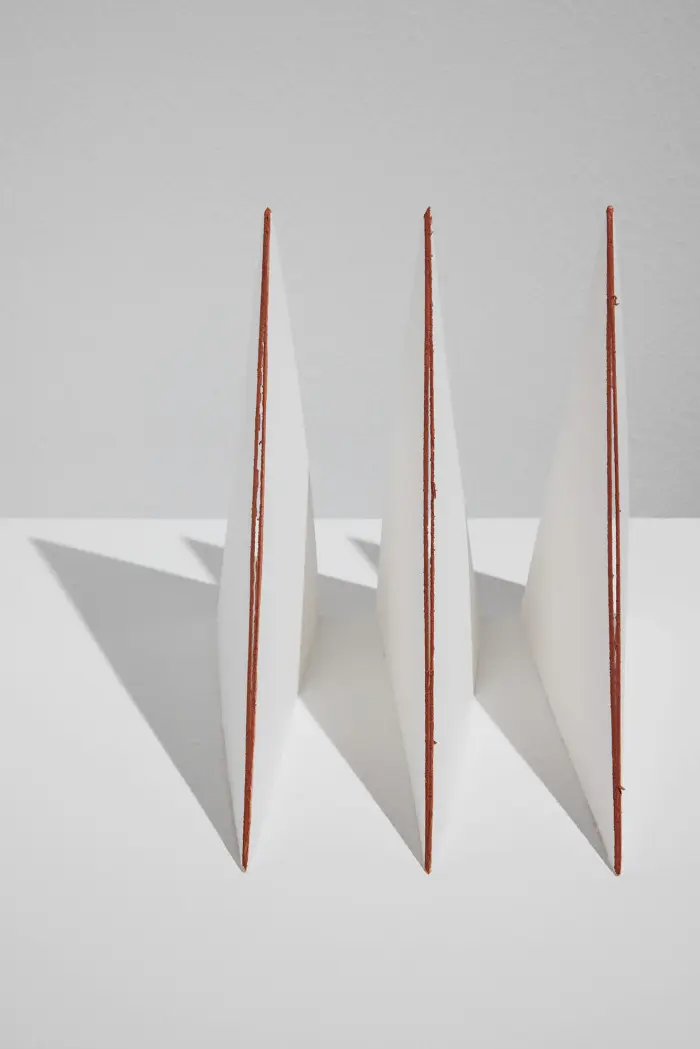
Developed alongside \ transverses the space, ultrafine brick dust collected from the process of breaking down debris was refined and sedimented by water into pigment. In \ dissects the square, this transformed matter becomes image: the diagonal emerges as a fissure across the paper plane, cutting through its strata. It is both a line of weakness, barely holding the two halves together, and a hinge of critical intervention that rearticulates the whole. The fracture opens a new dimension—as the form folds, the two sides converge. The square becomes two triangles; the surface becomes an object; stasis becomes movement. What we see—and what we know—is always already incomplete.
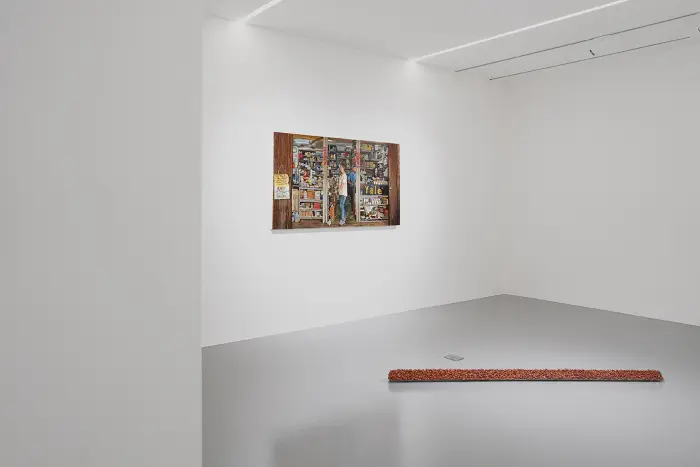
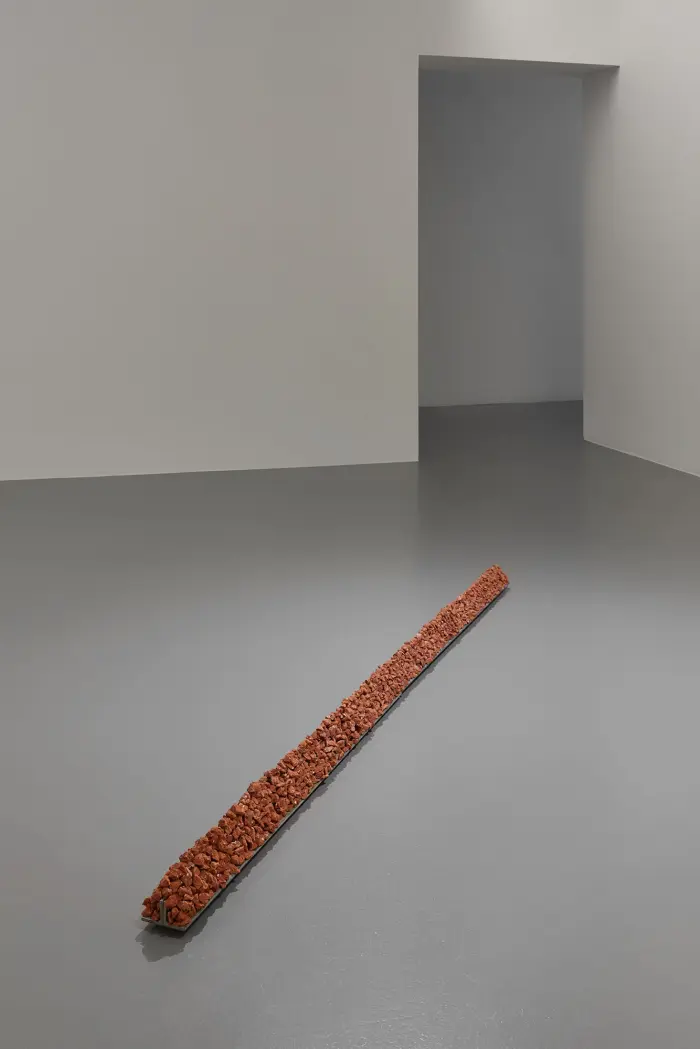
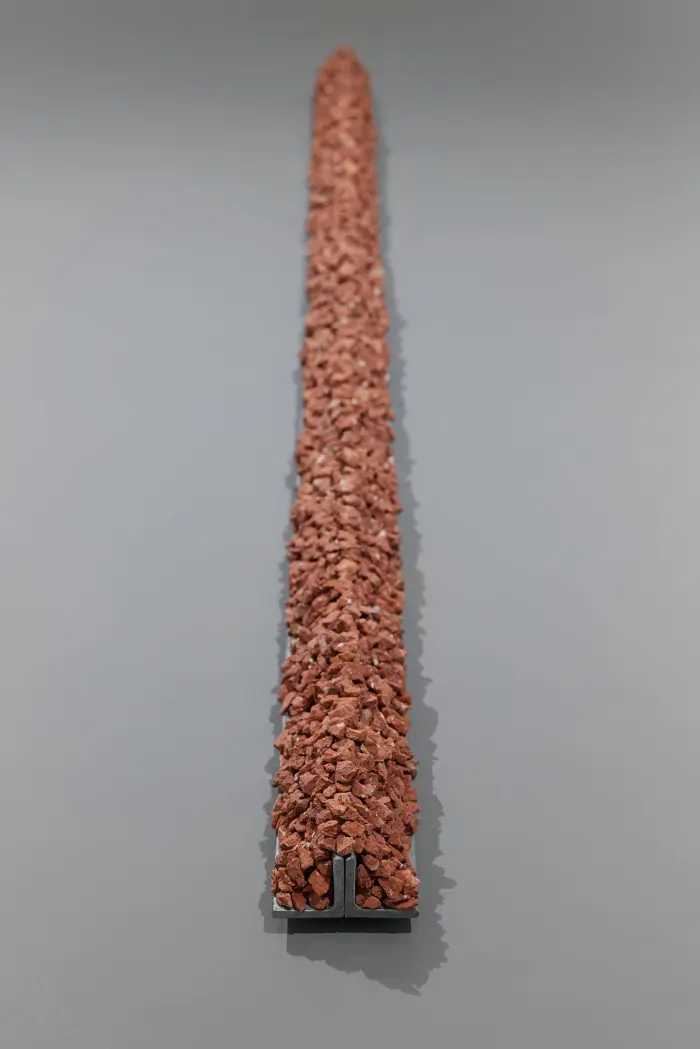
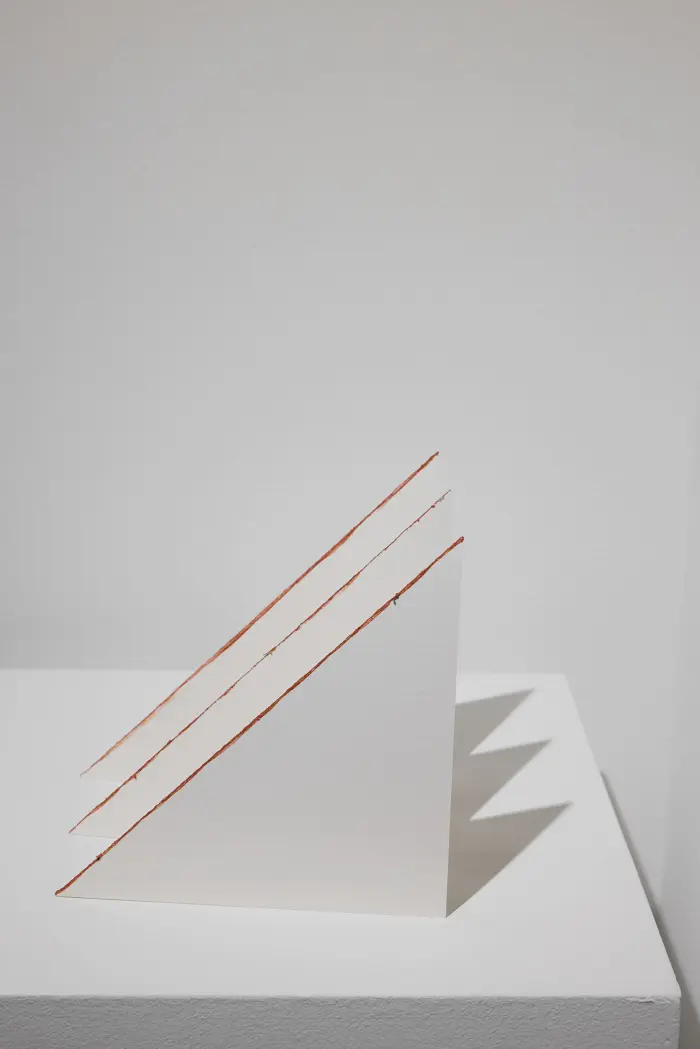
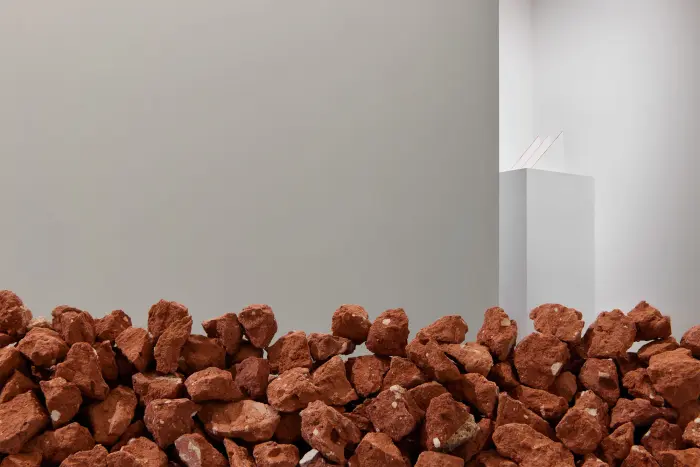
\ transverses the space I
2025
Approx. H7 x 100 x 7.6 cm
Crushed brick debris [approx. 30 – 15mm], galvanized mild steel and neodymium magnets
\ transverses the space II
2025
Approx. H7 x 100 x 7.6 cm
Crushed brick debris [approx. 23 – 10mm], galvanized mild steel and neodymium magnets
\ dissects the square I, II, III
2025 - ongoing
Approx. H20 x 20 x 4 cm
Cold pressed 640gsm watercolour paper, brick dust [< 190 micron] and aqueous acrylic binder
Images courtesy of FOST Gallery and Lavender Chang