Textile wall - woven space, woven time
Presented at Towards Happiness, Prosperity & Progress: Reflections on the Singapore Spirit
The Private Museum landmark exhibition bringing together 60 Singaporean and Singapore-based artists, 60 artworks, and 6 curators in a collective reflection on the Singapore spirit, marking 60 years of national independence.
Curated by Andrea Fam, Deborah Lim, John Z.W. Tung, Kirti Upadhyaya, Michael Lee, and Michelle Ho
Textile wall - woven space, woven time continues a line of inquiry into salvaged matter and sedimented memory, presenting the second instalment in a series of works composed from crushed local brick debris. Here, the brick is not treated as inert material, but as a form of terra in situ – a ground-specific matter imbued with historical density and geo-cultural trace.
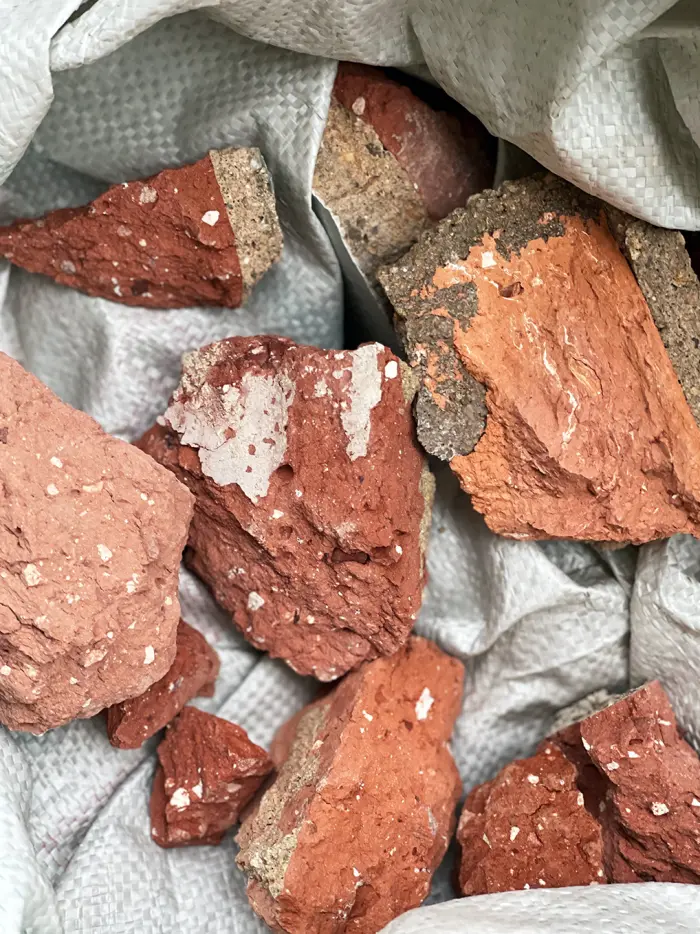
The bricks, fabricated from clay extracted from Singapore’s own terrain, bear witness to a time when the island’s earth was actively shaped into its built environment. The local brick industry, once thriving on what was described as an “abundant supply of suitable raw materials,” gained traction during the rapid urbanisation following Singapore’s post-1965 independence. Geologically, Singapore comprises three major rock types; it is the sedimentary formations in the western region, specifically a reddish-purple clay, variously known as red clay, brick clay, or shale that served as the principal resource for domestic brick production. This clay is composed of large-sized particles mixed with sand and pebbles, offering a distinctive texture and chromatic register.
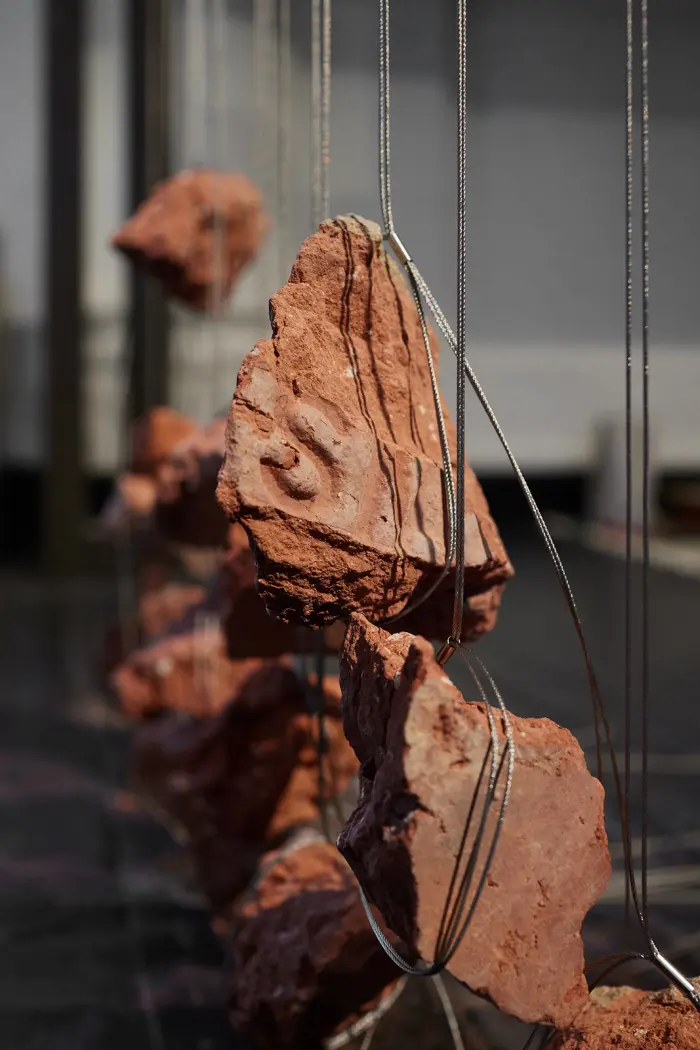
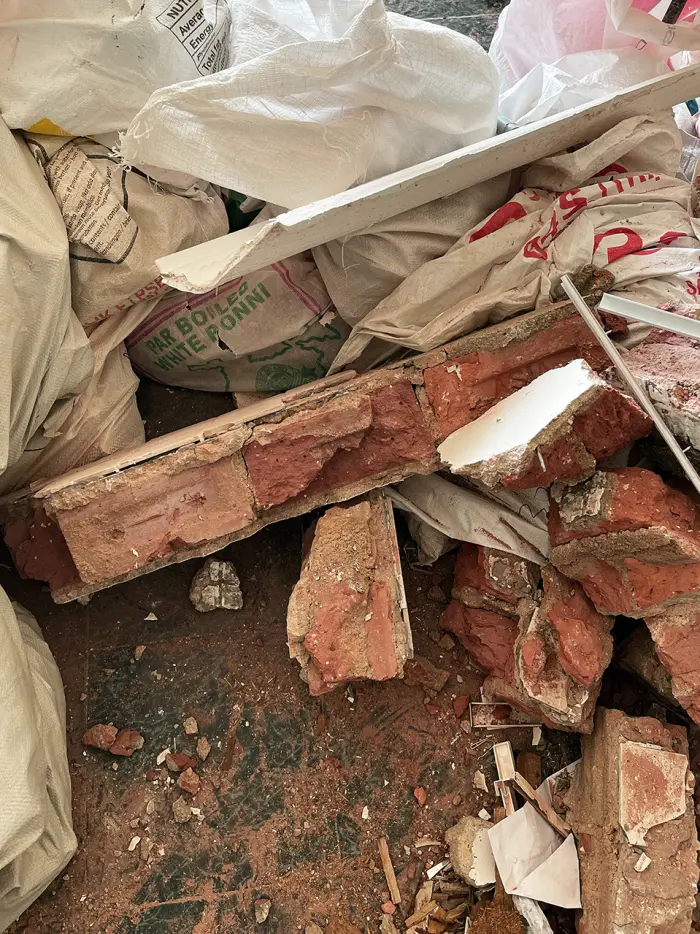
The brick debris used in this work originates from the demolished walls of a condominium unit at Hillcrest Arcadia, with bricks manufactured by both Asia Brick Factory and Bin Keow Brickworks, likely in the 1970s. Despite their shared origin, the bricks differ subtly in hue and aggregate composition. Their surfaces are flecked with white, sand-like particles, and reveal a heterogeneity that resists uniformity. It is precisely this variability that exerts the brick as a material of tension – not merely evidence of a construction past, but as sedimented presence: layered, disrupted, and enduring.
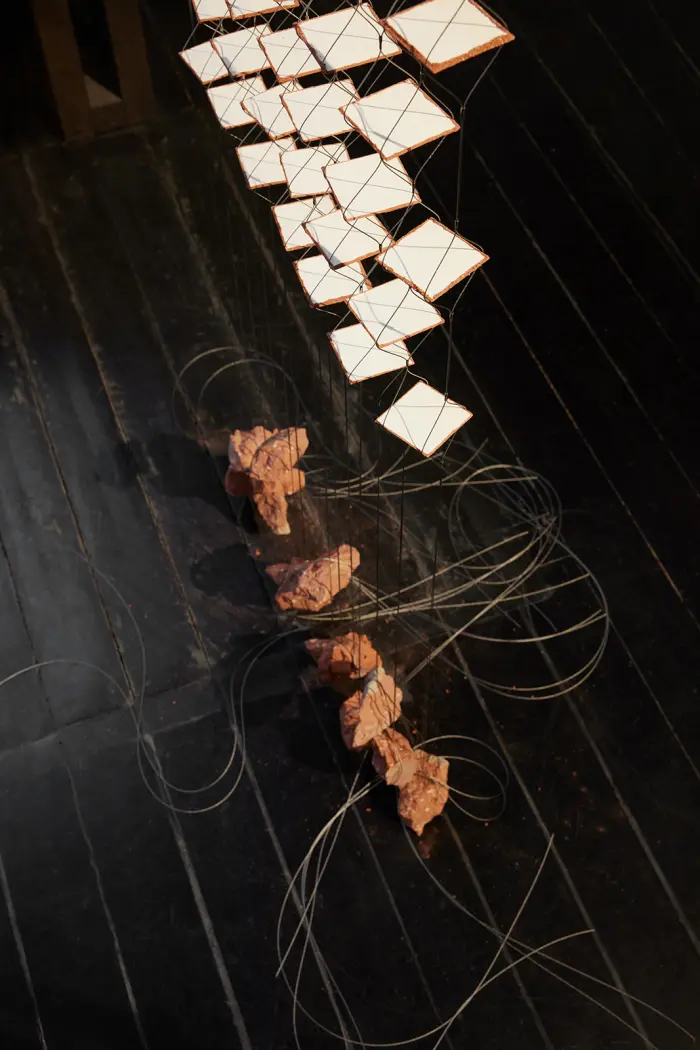
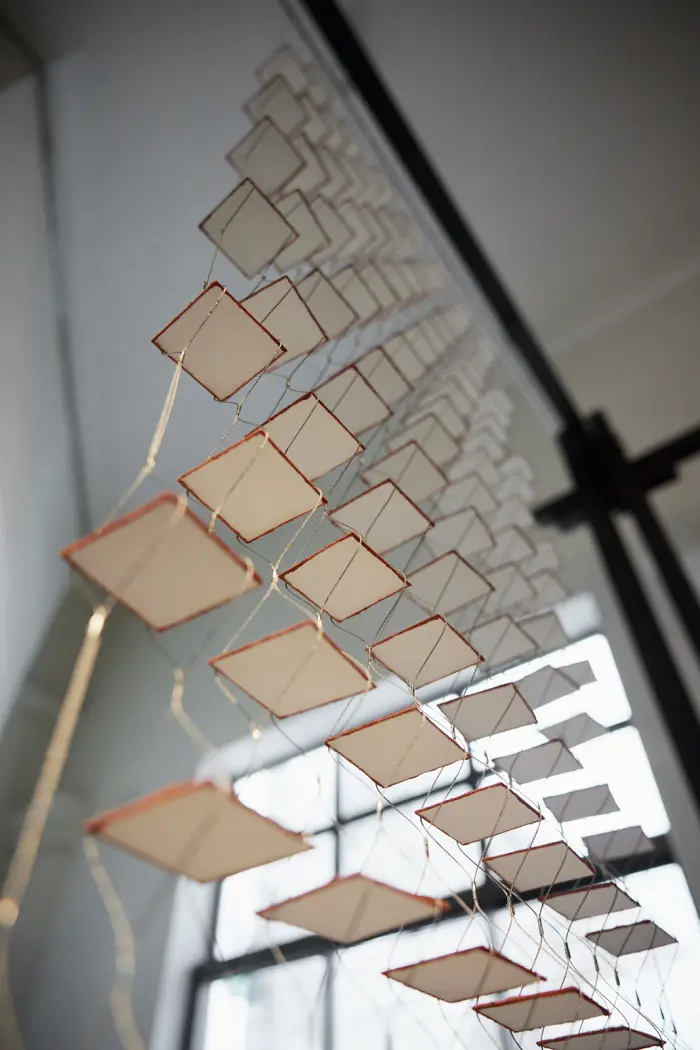
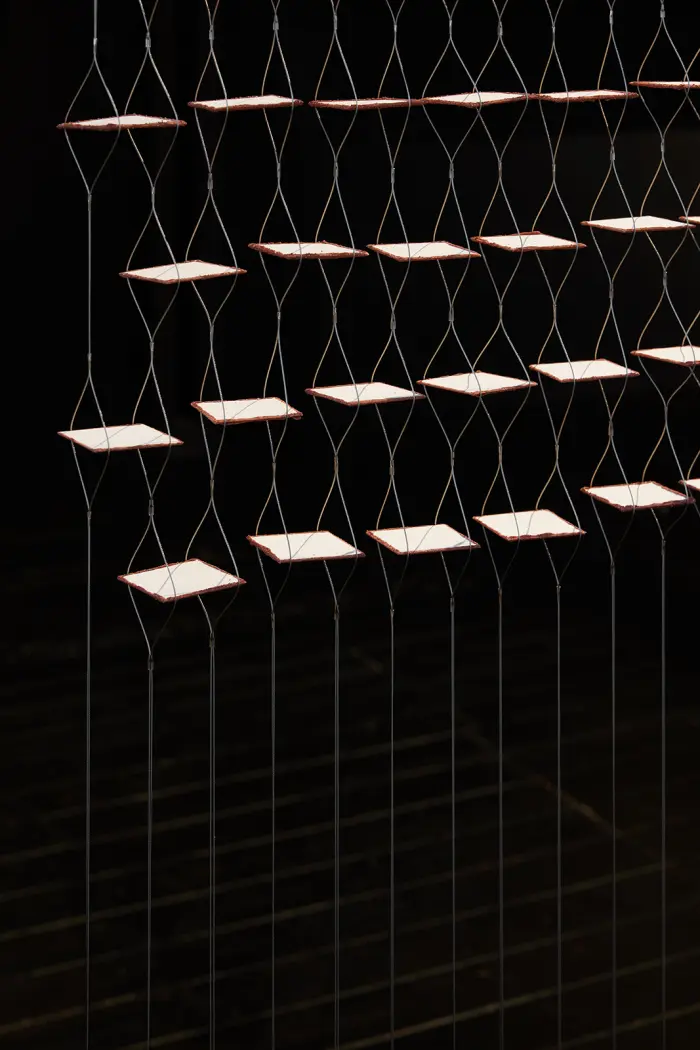
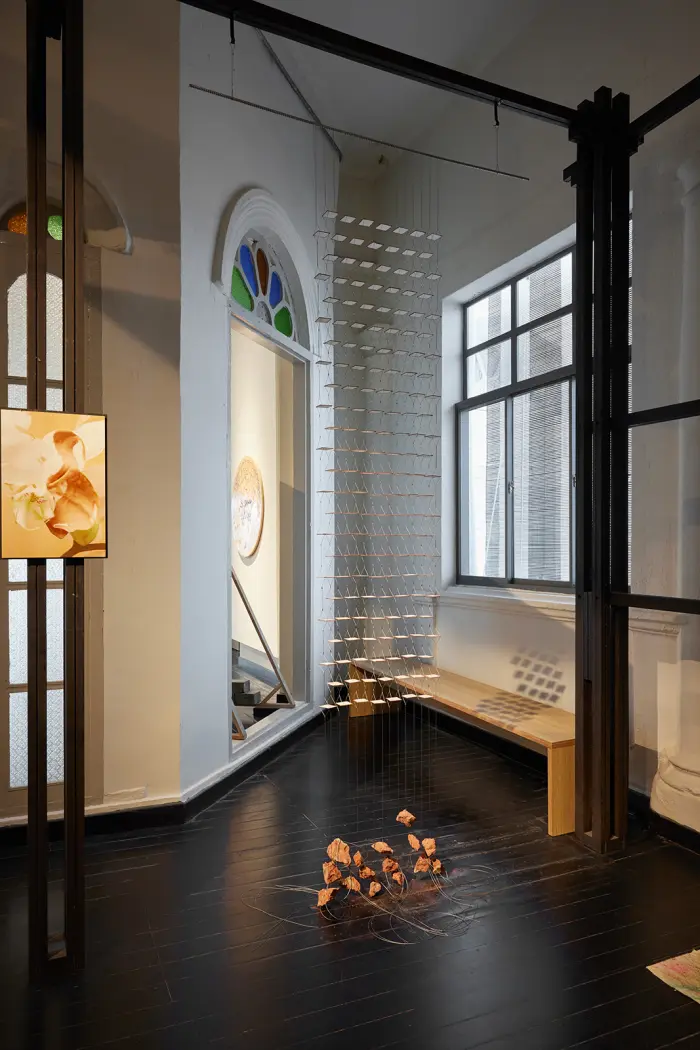
The work takes the form of a woven architectural structure, recalling both partition and screen. Brick dust is pressed into 5 x 5 cm paper squares, which are slotted between intervals of hanging stainless steel cables, and weighted with broken brick pieces at the base. In format and gesture, it recalls the earlier 2023 piece Textile wall, in which the act of weaving was proposed as an origin of tectonic articulation, an architecture not built from mass, but from interlace and relation.
Here, the weaving of space becomes a weaving of time: a temporal-material fold where historical construction, domestic ruin, and architectural abstraction intersect. As a structure assembled from terra in situ, earth held in place, not displaced – the work resists the erasure of locality. Instead, it proposes a poetics of groundedness, where material remains not as debris, but as a living archive of soil, industry, memory, and form.
Textile wall - woven space, woven time
2025
Dimensions variable
Cotton pulp watercolour paper squares with brick dust and archival PVA adhesive, stainless steel 316 ropes, nickel-plated brass sleeves, steel rebar with galvanising paint and salvaged brick debris (ASIA and BIN KEOW)
Photography by Lavender Chang with selected images by the artist